Validate
Rapid System Read™
A structured diagnostic that applies the OS to build an evidence-led picture of your current state and identify where attention is needed first.
Explore Rapid System Read™ →
The Culture Craft OS™
The way people work together is shaped by more than values, personalities or leadership intentions. It’s shaped by the systems they work within: how work is designed, decisions are made, managers lead, concerns are heard and people are rewarded.
Culture Craft OS™ is our proprietary People Operating System. It provides a structured, research-informed way to understand those conditions, identify where they are helping or hindering performance, and determine what needs to change.
When the people side of a business isn’t working, the answer shouldn’t depend on whoever has the strongest opinion in the room. It should start with a better understanding of the system.
Why we developed it
Culture is often discussed through values, behaviours, engagement scores or individual experiences. Each can offer useful insight, but none tells the whole story on its own.
A team might describe itself as collaborative while decisions stay concentrated at the top. An organisation might have clear values but inconsistent management. People might feel unheard, while a formal process for raising concerns rarely leads to action. These aren’t necessarily separate problems. They can be connected symptoms of the way the organisation operates.
Culture Craft OS™ was developed to provide a more coherent way to examine those connections. It changes the question from “What’s wrong with our culture?” to a more useful set of questions.
Culture Craft OS™
Each domain is a distinct lens. Together, they create a broader view of the people system, helping us examine not only what is happening, but the organisational conditions contributing to it.
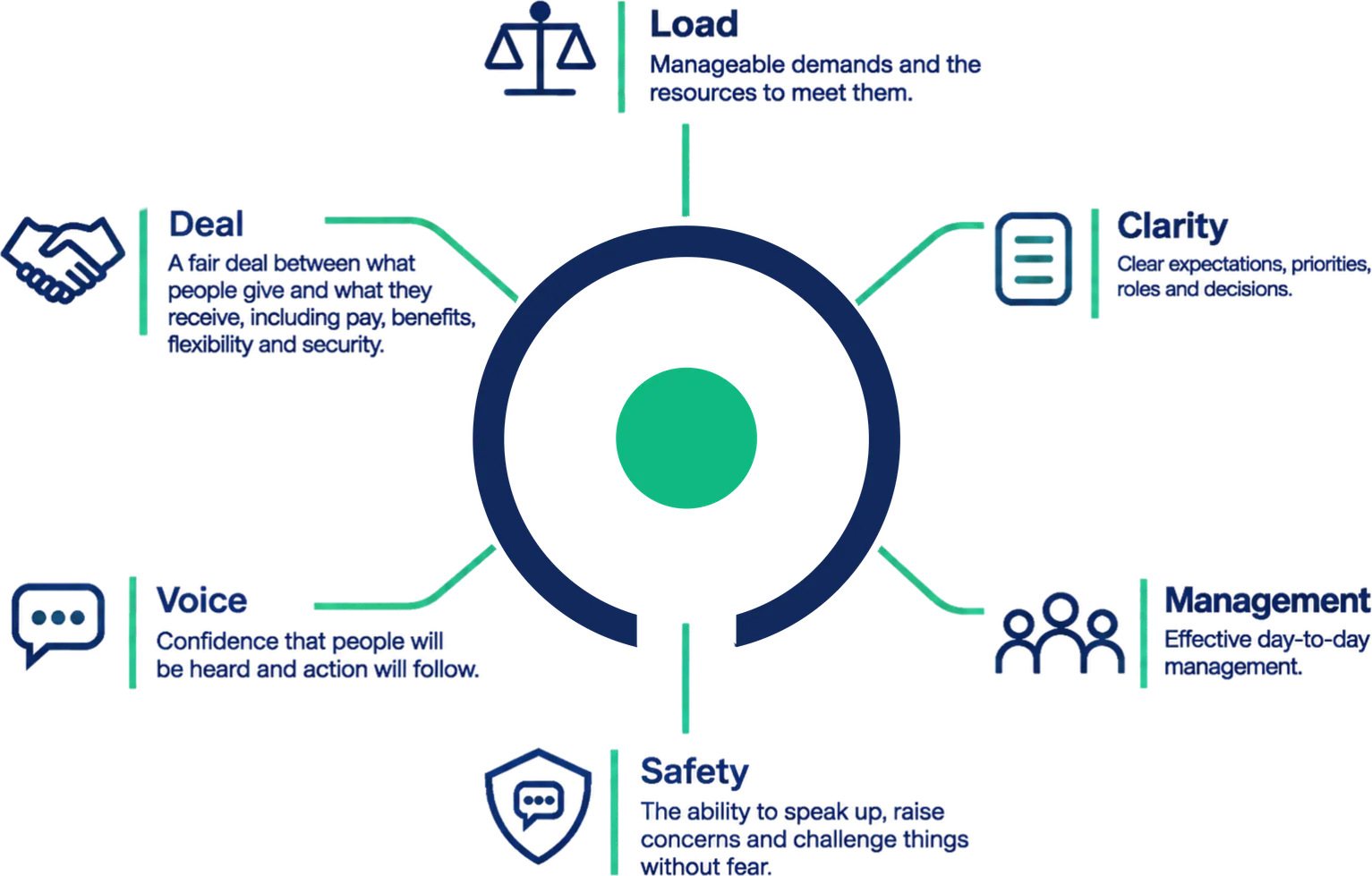
Load examines the demands placed on people and whether work is designed to be sustainable: workload, resourcing, working hours and the balance between what is expected and the capacity available to deliver it. When Load isn’t working, the symptoms can look like poor performance, exhaustion or persistent firefighting. The underlying issue is often how work is structured, allocated or resourced.
Clarity examines role expectations, objectives, autonomy, decision-making rights and how change is handled. Without it, people can be busy without being aligned: decisions stall, responsibilities overlap and people wait for direction. Clarity is about creating the conditions for people to understand their contribution and act with appropriate ownership.
Management examines line-manager capability and the processes managers are expected to operate: how priorities are set, feedback is given, performance is addressed and development happens. Management practices can reinforce or undermine the conditions across every other domain, so this is about how the system operates in practice, not simply individual skill.
Safety examines the physical and psychological conditions of work, including relationships, conduct and whether people can raise mistakes or concerns without fear of unfair consequences. It looks beyond whether a policy exists to what happens in practice. A reporting route does not by itself mean people feel able to use it.
Voice examines how concerns, ideas and feedback are raised, heard and acted upon: consultation, participation and the mechanisms through which people influence decisions that affect their work. The distinction that matters is between giving people a channel to speak and having a system that can listen, respond and demonstrate what changes as a result.
Deal examines the employment relationship: pay, contractual arrangements, security, flexibility, family provision and wellbeing support, and how consistently those arrangements are applied. The Deal is more than a list of benefits. It shapes how the whole relationship is experienced and whether its terms support the organisation’s ambitions.
The thinking behind the framework
Culture Craft OS™ is grounded in the convergence of established research, professional frameworks and regulatory perspectives on the conditions that shape work. Its foundations draw on several distinct bodies of knowledge.
These sources do not all describe the workplace in the same way, nor were they developed for the same purpose. That is precisely why their relationship matters. We look for meaningful convergence across independent perspectives rather than relying on one model to explain the whole picture.
The result is not a repackaging of a single existing framework. It is Culture Craft’s own synthesis of the evidence into a practical operating model for understanding and improving the people systems of growing businesses.
Individual experiences matter, but they are shaped by the environment people work in. We direct attention to the structures, decisions, processes and management practices behind those experiences, rather than treating culture as a personality issue.
The six domains are distinct but not isolated. A problem that appears to sit in one area may have causes or consequences elsewhere. The framework gives us a way to examine those relationships rather than treating every symptom as a standalone issue.
The framework’s foundations can be traced to published research and recognised external frameworks. That gives it a stronger basis than personal preference, while recognising that research informs the framework rather than proving what is happening in any one organisation.
Seeing a problem is not the same as understanding it. We place importance on the quality of the evidence behind a finding, what it can reasonably support and where uncertainty remains. We do not treat confidence as a substitute for substantiation.
The purpose is not another abstract culture assessment. It is to help establish what is happening, where attention is needed and what practical changes could improve the way the business operates.
Consider reward and recognition. It might look like a question of pay, benefits or how contribution is acknowledged. But the underlying challenge could also involve how managers recognise performance, whether people have a voice in decisions, or how clearly progression and expectations are communicated.
The relevant domains depend on the problem being examined. Workload can be affected by unclear priorities. Voice can be shaped by management behaviour. The experience of a reward decision can depend on both the terms of the deal and the way it is communicated and applied.
A solution that addresses the visible symptom but leaves the underlying conditions untouched tends to have limited impact. Understanding the wider system helps us identify a more appropriate response.
Culture Craft OS™ underpins how we work across Culture Craft. It informs the questions we ask, the conditions we examine and how we connect findings to action — understand the system, identify what needs to change, and build the conditions for the business and its people to perform.
Validate
A structured diagnostic that applies the OS to build an evidence-led picture of your current state and identify where attention is needed first.
Explore Rapid System Read™ →Build
Turns the priorities into practical change: the processes, tools and ways of working your team needs, delivered in focused sprints.
Explore People System Build →Run
Ongoing people-operations support for businesses that need the people side held, day-to-day, as they grow.
Explore Grow™ →Culture Craft OS™ is Culture Craft’s proprietary People Operating System. It is a research-informed framework for understanding how the structures, working conditions, management practices and employment relationship within a business shape people’s experience of work and the organisation’s ability to perform. It is organised around six connected domains: Load, Clarity, Management, Safety, Voice and Deal.
The six domains are Load, Clarity, Management, Safety, Voice and Deal. They cover the demands of work, role and decision clarity, management practices, physical and psychological safety, employee voice, and the employment relationship. Together, they provide a structured way to examine the people system without reducing culture to a single score.
Yes. Its foundations draw on published research and established frameworks, including the HSE Management Standards, the CIPD Good Work Index, the Job Demands–Resources model, self-determination theory and psychological safety research. These perspectives inform the framework’s structure and help connect workplace conditions to established evidence.
Rather than relying primarily on surveys, stated values or a consultant’s interpretation, Culture Craft OS™ provides a structured framework for examining the organisational conditions that shape culture. It brings together connected domains and supports an evidence-informed approach to identifying problems and deciding what needs to change. The framework informs the analysis; the evidence gathered in a particular organisation determines what can be concluded about it.
No. Culture Craft OS™ is the underlying framework. The Rapid System Read™ is a structured diagnostic that applies this foundation to examine an organisation’s current state and identify priorities for action.
The framework is designed to help growing businesses understand and improve the people systems that support their work. The specific issues, evidence and priorities vary by organisation, but the six domains provide a consistent way to examine the conditions that shape how people work together.
If the people side of your business feels harder than it should, the answer may not be another policy, initiative or conversation about values. It may be time to understand how the system is working.
When culture works, everyone wins.
Prefer to email? info@culturecraft.team